
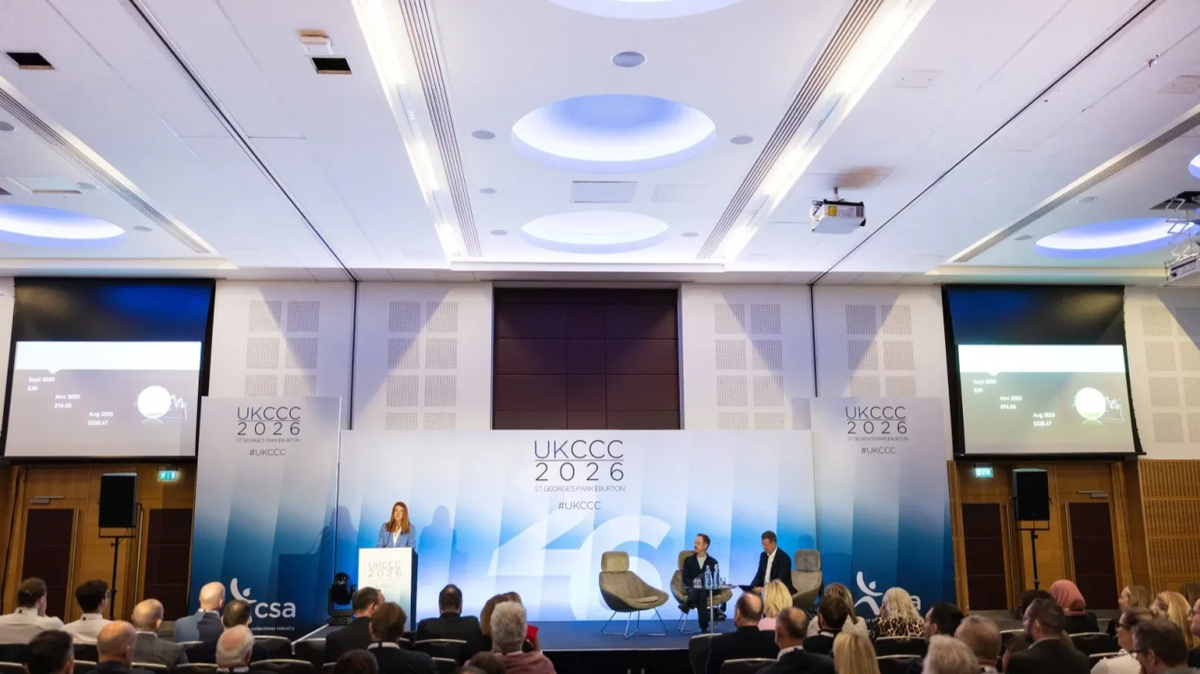
I spent yesterday at the UK Credit and Collections Conference, mainly to get a proper read on where the sector is with AI adoption and what it's dealing with more broadly.
Within our workshops at Zygens we talk about tool-first versus strategy first all the time. Tool-first is where you either default to the systems you already have, because the vendor has added AI to them and it feels like the natural place to start, or you buy something new to solve the obvious high value problem sitting in front of you. Strategy first is working out where the value actually is across the business, and then deciding what you need, to get at it. After yesterday it was very apparent that this sector is going tool-first, more so than the other parts of financial services we work with.
I understand why. It feels like the easier, safer, more practical option, particularly when you're already dealing with security, risk, implementation and adoption of AI all at the same time.
But there's more to it than that.
A key blocker is ownership, not technology
From the conversations I had yesterday, and from what we see across our clients, the problem is that people don't have the resource or the time to properly invest in this. There are a huge number of quick wins sitting there in AI. Every single one of them needs somebody to own it and push on it internally.
Without that person, nothing moves. And when nothing moves, buying a tool starts to look like progress. It gives you something to point at. It has a contract, an implementation date, a vendor who will answer the phone. It feels like a decision has been made.
The trouble is that the decision has been outsourced rather than made.
What tool-first actually costs you
The first cost is vendor lock in, in a market that is evolving faster than any procurement cycle can handle. One of the debt purchase panels made this point better than I could. They'd built a piece of software two years ago on one model version, and it's falling over now they're several versions on. Their words were that it's moving so quickly they find it very hard to work out the investment decision at all. That is a serious buyer, with capital and appetite, saying out loud that they cannot write the business case.
The second is the old SaaS story. You buy a system, and it does about 20% to 30% of what you actually wanted.
But the real cost is the diagnosis that never happened. If you don't get under the skin of where your problems and opportunities genuinely are across the business, you don't find out that a lot of these use cases could be built internally, on the tech stack you already pay for. Copilot, in most cases. Firms are buying capability they already own because nobody had the time to go and look.
The regulator has given the sector room, and the sector has used it well
The FCA were clear that they're encouraging firms to innovate and aren't planning to write new AI rules. Tech neutral, but as they put it on the day, tech neutral doesn't mean tech blind. There's a substantial section in the Mills review on agentic AI and the shift from systems that recommend to systems that decide, and the position is that they'll be led by the evidence, with the door open.
Personally I think that will have to change in the not too distant future. But for now it's clear, and firms know what they're working with.
It keeps coming back to what we advise every client. Start small, with high value, low risk use cases where you can see real ROI without running into your regulatory restrictions. What's worth saying is that this sector has already done exactly that in some areas. Around half of debt purchasers now run AI QA. It started in the back office where the risk is contained and the failure mode is visible. It's quietly the biggest governance change the sector has made.
The consumer confidence numbers are a starting point, not a verdict
The CSA's polling found 70% of people still want a human when they raise a complaint or share personal circumstances. Only 8% of over 65s are comfortable with AI even for basic account information.
The way those numbers normally get used is as a reason to hold off. But that's not what they're saying. They're saying the experience isn't there yet, and that's a very different problem to solve.
The FCA panel made the point that a survey on mobile banking would have looked much the same, and the FCA's own Financial Lives data backs that up. 41% of account holders used a banking app in 2017. 75% by 2024. Over 75s are still at 41%. Adoption followed experience, and it took the best part of a decade to get there.
This is the curve collections is at the start of. It isn't a verdict on where it ends.
Which is what made Hans Zachar's session the most interesting of the day for me. Nutun run around 100,000 AI voice calls a day across a quarter of a million accounts. They went in expecting widespread rejection and got close to the opposite, because when you're speaking to people at an emotional point in their lives, a lot of them are more comfortable talking to a bot than to a human.
His caveats were the useful part. Doing it well is not cheap. There's a direct correlation between what you spend per minute and the quality of the call. It took them years to get below the cost of a human agent. They stay away from frontier models entirely because of cost and token consumption, and run the smallest models that will do the job. And his line that it isn't one bot for all obligations, that AI has its place and humans still have theirs.
The saving belongs to whoever can achieve it
AI savings are harder to get than the pitch decks claim. But what surprised me at this conference was that nobody in the debt purchase market was willing to price a single pound of future AI saving into their numbers.
A sector that is already capturing value from AI, getting more out of back books through strategies that were never priced into the original deals, will not put one pound of it in a forecast. Not because the gain isn't real, but because the price you pay for a book is permanent and the saving is a forecast. Price it in and you've spent it before you've earned it. Leave it out and, if the AI delivers, it drops straight to your margin.
Right now that saving belongs to whoever can actually achieve it, because the market hasn't priced it in yet. That window closes on its own. As more buyers get there, bids rise, and the advantage moves from the firms doing the work to the sellers they're buying from.
Where this goes
I spend a lot of my time playing with the new and shiny tools coming to market, and it does feel like a constant glimpse of where enterprise is heading. Sitting in conferences like this one and working with enterprise clients on their AI strategies gives me a view of what is actually happening, rather than what gets written about online.
I think we're moving towards a world where we each manage a number of agents, every one of them doing the work it's safe for them to do, which frees us up for what humans are actually best at. The creative, the strategic, the in person, real stuff.
Not everyone wants to learn this, and that's fair enough.
But if I'm right, the businesses that get there won't be the ones who bought the best tool. They'll be the ones who started somewhere small, with someone who owned it, a year before everyone else.
That's the whole argument for moving now. Not because AI is going to replace your operation, but because the capability to run it takes a lot longer to build than the software takes to buy.
If you want help working out where your real opportunities are before you buy anything, that's exactly what our Discovery Programme is for: zygens.com/what-we-do/agentic-ai-discovery
About the author

Charlie Bartle
Co-founder, AI Lab UK · CIO, Zygens
Charlie co-founded AI Lab UK and runs the lab programme on the ground. She works with SMEs, councils and universities to turn AI curiosity into working tools people actually use.